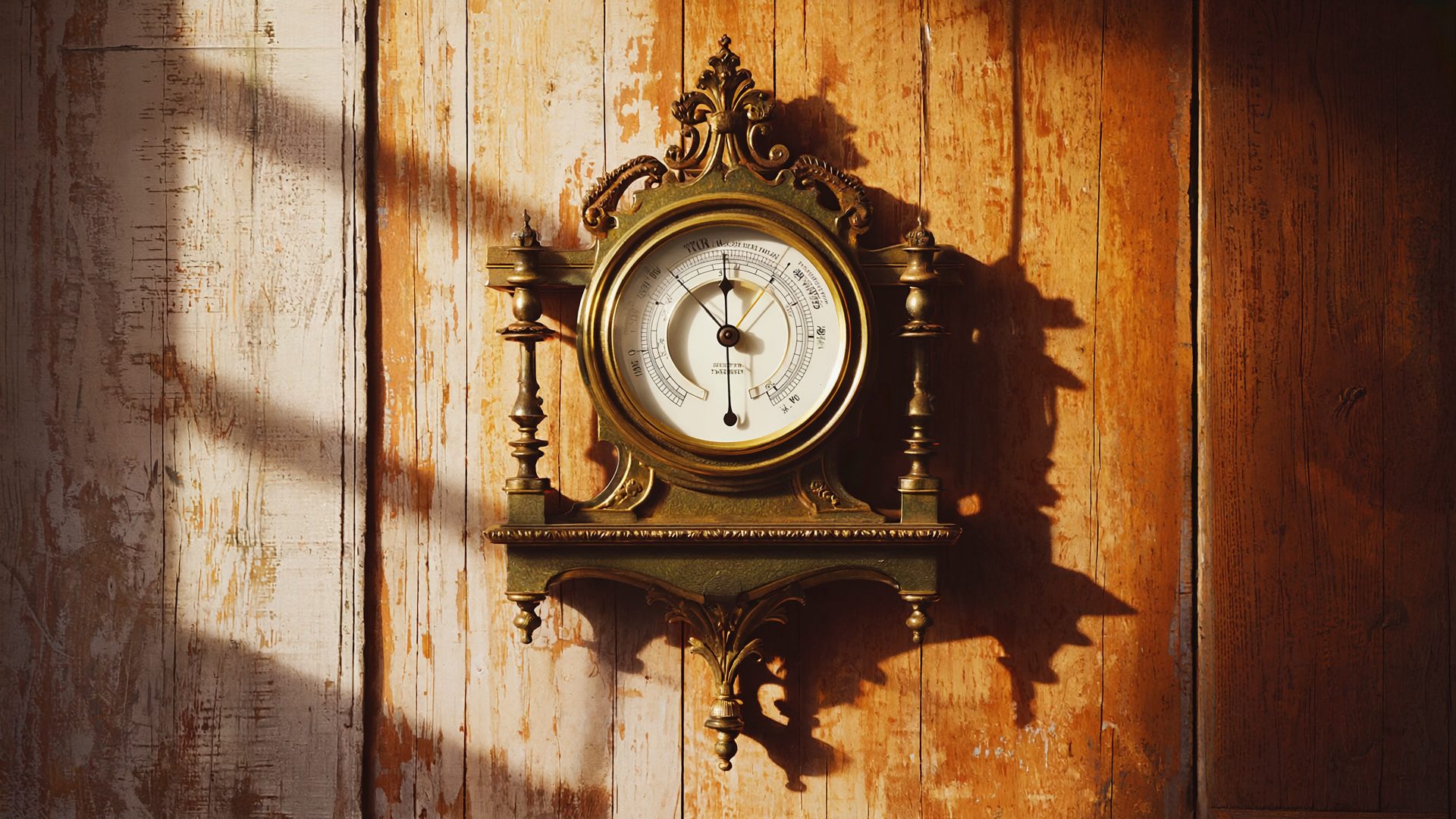
Before weather apps, before radar, before satellites, there was the barometer. Sailors, farmers, and fishermen on the Gulf Coast have used barometric pressure to predict weather for centuries. With a modern weather station, you have a digital barometer that logs pressure history automatically — making prediction easier and more precise than ever. New to the readings? Our Weather Station Data for Beginners primer explains the rest.
The Basics
Barometric pressure is the weight of the air column above you. It is measured in inches of mercury (inHg) in the US or millibars/hectopascals (mb/hPa) internationally. Standard sea-level pressure is 29.92 inHg (1013.25 mb).
Your weather station should report sea-level pressure (also called barometric pressure adjusted to sea level). This adjustment accounts for your elevation so that your reading can be compared to stations at different altitudes. Most stations ask for your elevation during setup to make this correction. South Louisiana is mostly near sea level, so the correction is minimal — but even 50 feet of elevation makes a 0.06 inHg difference if uncorrected. If you are still choosing a station, our best home weather stations guide covers models with excellent barometric sensors.
Reading the Trend
The absolute pressure value matters less than the trend — is it rising, falling, or steady? Most weather station consoles show a pressure trend arrow or a small graph of the last 12–24 hours. This is the most predictive piece of data on your display.
| Trend | Rate | Forecast |
|---|---|---|
| Slowly falling | 0.01–0.03 inHg/hr | Weather deteriorating in 12–24 hours. Rain or clouds likely. |
| Rapidly falling | 0.04–0.06 inHg/hr | Storm approaching within 6–12 hours. Possible severe weather. |
| Crashing | >0.06 inHg/hr | Intense storm imminent or overhead. Possible severe thunderstorm, strong cold front, or tropical system. |
| Slowly rising | 0.01–0.03 inHg/hr | Conditions improving. Clearing skies expected in 12–24 hours. |
| Rapidly rising | >0.04 inHg/hr | Cold front has passed. Clear, cooler conditions arriving quickly. Can bring gusty winds behind the front. |
| Steady | <0.01 inHg/hr | No significant change expected. Current conditions persist. |
Gulf Coast Pressure Patterns
Cold Front Passage (October–April)
The classic Gulf Coast winter pattern: pressure falls ahead of the front (often with rain and thunderstorms), then rises sharply as the front passes. You can track this on your barometer graph — the "V" shape of falling-then-rising pressure is unmistakable. The bottom of the V is when the front is passing your location, often accompanied by a wind shift from south to north and a temperature drop.
Strong cold fronts can drop pressure by 0.15–0.25 inHg in 6 hours ahead of passage. If you see pressure falling at 0.04+ inHg per hour in winter with south winds, expect the front (and its storms) within hours.
Summer Thunderstorms (May–September)
Summer afternoon thunderstorms on the Gulf Coast are driven more by daytime heating and moisture than by pressure systems. The barometric signature is subtle — a slight dip (0.02–0.05 inHg) as a mesoscale convective system approaches, followed by a rise as the outflow boundary passes. These swings happen in 1–2 hours rather than 12–24.
For summer storm prediction, your barometer is less useful than watching cumulus development and checking radar. But a sudden pressure drop on an otherwise quiet afternoon is a reliable signal that a nearby cell is strengthening.
Tropical Systems (June–November)
Approaching hurricanes produce the most dramatic barometric signatures. Pressure begins falling 24–48 hours before a major hurricane's arrival, accelerating as the system gets closer. The lowest pressure readings in your station's history will come during a direct hurricane hit.
Reference points for Gulf Coast tropical systems:
- 29.70–29.50 inHg: Tropical storm or distant hurricane influence
- 29.50–29.00 inHg: Hurricane making nearby approach
- Below 29.00 inHg: Major hurricane in close proximity
- Below 28.50 inHg: In or very near the eye of an intense hurricane
Hurricane Katrina's central pressure at landfall was 27.17 inHg. Hurricane Ida made landfall at 27.73 inHg. If your barometer reads below 28.00, you are in an extremely dangerous situation.
Combining Pressure with Other Readings
Pressure alone tells you something is changing. Combined with wind and humidity, it tells you what is changing:
- Falling pressure + rising humidity + south wind: Warm front or Gulf moisture surge approaching. Expect clouds and rain.
- Falling pressure + strong south wind + rapidly rising dew point: Possible severe weather setup. Watch for thunderstorm development.
- Rising pressure + dropping humidity + north wind: Cold front has passed. Clearing and cooling ahead.
- Slowly falling pressure + calm winds + high humidity: Fog likely overnight and into the next morning.
- Steady high pressure (30.10+) + light winds: Fair weather continuing. Common during Gulf Coast high-pressure ridges in summer (which also bring the hottest temperatures).
Calibrating Your Barometer
An uncalibrated barometer is useless for prediction. To calibrate:
- Find the current altimeter setting from your nearest airport METAR (search "[airport code] METAR" or use aviationweather.gov)
- Compare to your station's reading
- Apply the offset in your station's calibration settings
- Recheck after 24 hours to confirm stability
For most Gulf Coast locations near sea level, the correction is small. But even a 0.05 inHg error can lead to wrong predictions, so calibrate when you first set up and verify quarterly.
Recommended Stations with Good Barometer Displays
- Ambient Weather WS-5000 — Detailed pressure graphs in app ($330–$380)
- Davis Vantage Vue — Console shows pressure trend arrow ($350–$400)
- Ambient Weather WS-2902 — Color console with pressure history ($170–$200)
- SensorPush HTP.xw — Lab-grade barometric sensor with app ($80–$100)
★ Recommended Reading & Gear
- The AMS Weather Book — Comprehensive guide to understanding atmospheric pressure, fronts, and storm mechanics
- Weather Station Handbook — Detailed barometer calibration and pressure trend interpretation techniques
- SensorPush HTP.xw — Lab-grade barometric sensor with app-based pressure graphing ($80–$100)
Bottom Line
Your barometer is the most predictive instrument on your weather station. Watch the trend, not the number. Falling pressure means weather is coming; rising means it is leaving. On the Gulf Coast, the rate of pressure change tells you how fast and how severe the change will be. Check the pressure trend every morning alongside your coffee — within a few weeks, you will be calling weather changes before your phone app does.
Frequently Asked Questions
What barometric pressure indicates a storm is coming?
A falling barometric pressure trend is the key indicator -- a drop of more than 0.06 inHg per hour suggests significant weather within 12-24 hours. Readings below 29.80 inHg often accompany active storm systems. During hurricanes, pressure can drop below 28.00 inHg near the eye wall.
What is normal barometric pressure?
Standard sea-level barometric pressure is 29.92 inches of mercury (inHg) or 1013.25 millibars. Normal daily fluctuations range from about 29.70 to 30.20 inHg. Pressure below 29.50 inHg typically indicates a strong low-pressure system, while readings above 30.40 inHg signal a strong high-pressure system bringing clear, stable weather.
How accurate are barometer-based weather predictions?
Barometric pressure trends predict weather changes 12-24 hours out with roughly 70-80% accuracy for general conditions (clearing vs. deteriorating). The faster the pressure change, the more reliable the prediction. Barometers are best at predicting frontal passages and storm approaches but cannot predict specific precipitation amounts or temperatures.
Do I need to calibrate my barometer to sea level?
Yes. Your weather station barometer must report sea-level adjusted pressure so your readings can be compared to official forecasts and other stations. Most stations ask for your elevation during setup to make this correction automatically. Even 50 feet of elevation causes a 0.06 inHg difference if uncorrected, which is enough to throw off your predictions.
What does it mean when the barometer rises quickly after a storm?
A rapid rise in barometric pressure after a storm means a cold front or high-pressure system is moving in behind the departing low. This typically brings clearing skies, lower humidity, and cooler temperatures. On the Gulf Coast, a post-frontal pressure rise of 0.04 or more inHg per hour often comes with gusty north winds and a noticeable temperature drop within a few hours.
Explore More Reviews
- Best Air Purifiers for Home Office on DeskSetupPro
- Best Cooling Sheets for Summer on RestWell